You navigate in the terrain and still lose your sense of direction.
In the middle of the forest, on a steep slope or in poor visibility – those who rely solely on electronic devices can face challenges when there is no signal or the battery is dead. The military compass with integrated clinometer supports you in orientation, enables the measurement of slope angles, and works without batteries or electronics. The result: a reliable navigation aid for use in the field, independent of mobile reception or power supply.

Benefits
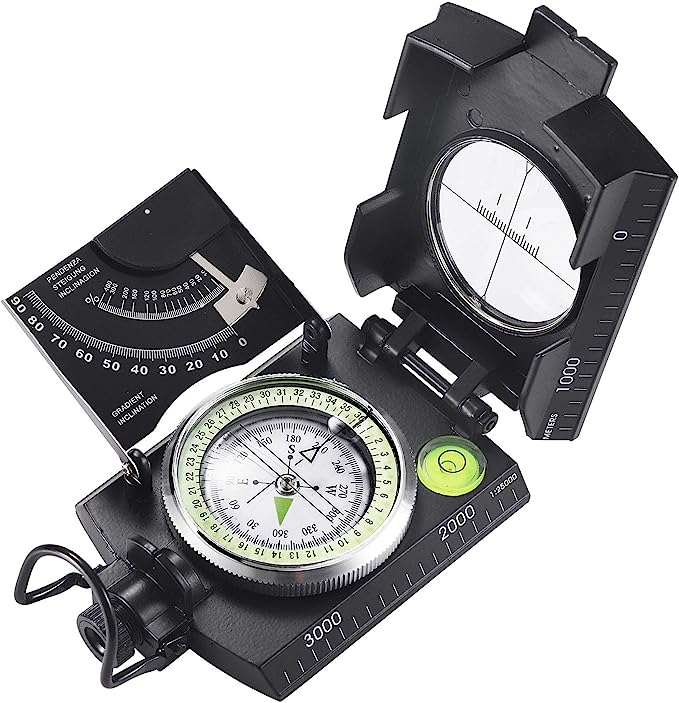
- No more lost orientation: Thanks to the 360-degree compass dial and the sighting window with crosshair, the compass supports direction finding even in challenging terrain – for targeted navigation without constant guessing.
- No time wasted reading: The luminescent dial, magnifier, and thumb holder facilitate reading under different lighting conditions – for comfortable use on the go.
- No more worries about defects: The zinc alloy housing and liquid-filled capsule are designed for outdoor use and support rugged operation in various weather conditions.
Specifications
- Color: Black or Green
- Dimensions: 9.98 x 6.60 x 3.10 cm
- Weight: Approx. 295 g
- Material: Zinc alloy, waterproof housing
- Features: Integrated clinometer, adjustable diopter lens, rotating bezel, unit conversion table, luminescent markings

Usage
- Align: Hold the compass horizontally and use the integrated spirit level for exact horizontal alignment.
- Sighting: Look through the eyepiece, align the crosshair with your target object, and read the bearing angle on the 360-degree scale.
- Measure slope: Fold out the clinometer and read the slope angle directly – helpful for assessing slopes or estimating height differences.
Pro tip: Calibrate the diopter lens once to your eye before heading into the field – this way you can read much faster under stress and on the move without readjusting.